
"Before I become a client, I want to understand how you actually invest."
That’s one of the best questions we get — and it should be. A lot of firms talk about “customized portfolios” and “disciplined process” without ever explaining what that means...our philosophy shows up in our daily decisions: what we buy, what we don’t, when we adjust, and when we leave things alone. And if you're an existing client, let this serve as a reminder of why you hired us in the first place. Today's investor is surrounded by financial noise; use this to cut through the clutter.
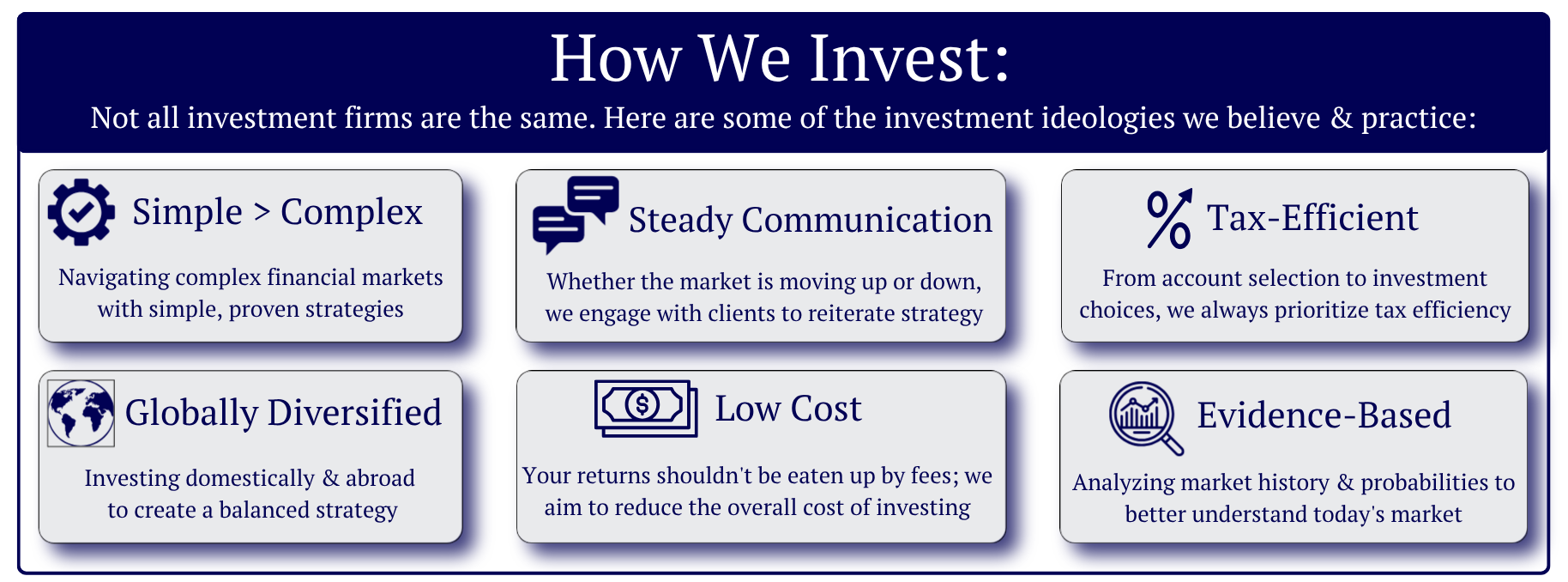
Diversified, Low-Cost, and Disciplined. The core of our investment approach starts with building diversified, low-cost portfolios using primarily passive strategies and broad-market index funds (usually ETFs). This serves as the foundation for every client who trusts us to manage their money. We believe these 4 concepts do most of the heavy lifting over time:
Just as important as how we invest is what we refuse to do. We avoid the "great opportunity" or "limited time only" investments that take a 20-minute explanation, a two-page fact sheet, and a leap of faith. If it sounds too good to be true, it probably is. These are traditionally warning signs — not a badge of sophistication. We stay away from products that are:
We generally avoid the usual suspects: engineered structured products, high-cost active strategies that claim to "beat the market", illiquid "private deals" that don’t clearly improve the plan, and anything that relies more on a story than on evidence. Complexity is easy to sell. It sounds exclusive. It rarely improves the odds. Most of the time, broad-market index funds do the job better: lower cost, easier to tax-manage, easier to rebalance, and easier for you to actually live with when markets get ugly.
A large share of our client assets are invested through model portfolios. The concept allows for our overarching philosophy to be shared across every household, regardless of individual risk profile. Our models range from conservative to moderate to aggressive and everywhere in between. Some benefits of models are the ease of trading, monitoring, and rebalancing multiple accounts systematically.
But we don’t believe every client needs to be squeezed into a predetermined model portfolio. While models give us structure for managing risk and asset allocation for the core of a client's portfolio, we often customize strategies to surround the foundation. For example, we can customize around:
A common example: a client already owns some individual stocks they want to keep, often times due to the tax bill that comes with selling. Instead of forcing those positions into a model that pretends they don’t exist, we can build the rest of the portfolio around them. We also incorporate individual stocks, specialized investments, or strategies outside our traditional models when they serve a specific purpose inside the overall financial plan. Portfolio management is more than picking funds off a shelf.
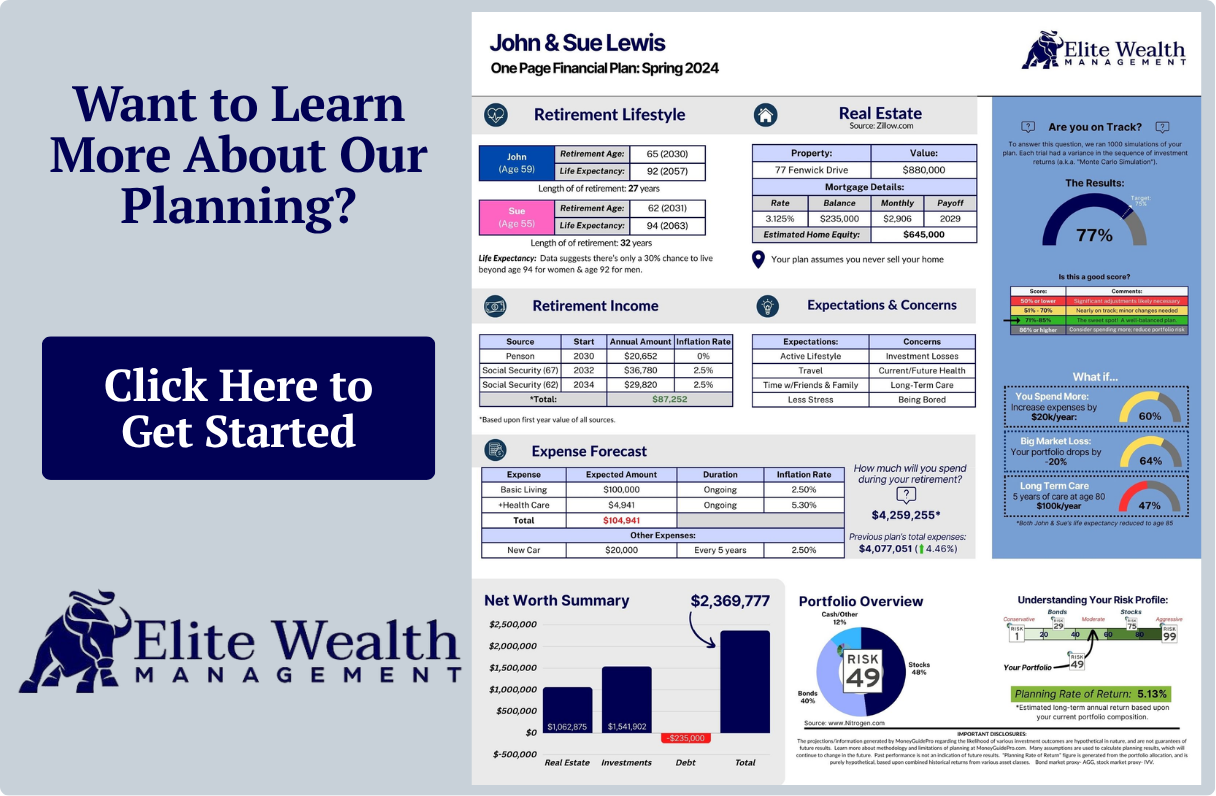
Investment management without a plan is just an educated guess. Your financial wellbeing deserves more than guesswork. That’s why planning sits at the center of how we work. Your portfolio is a tool; your plan tells that tool what job to do. A living financial plan answers the questions a model allocation never will on its own:
Those answers change the investment strategy. Two households can have the same risk tolerance on paper and still need very different portfolios. Example: one client is still working, in a high tax bracket, and doesn’t need portfolio income for 12 years. Another is two years from retirement, will need withdrawals, and already owns a large position in company stock they don’t want to sell. Same “growth” label. Completely different build. That’s why we don’t treat investing as a separate product. Asset allocation, tax location, withdrawal sequencing, and risk management all come out of the plan. When the plan changes — a job transition, a liquidity event, a new tax law, a shift in spending — the portfolio can change with it. When the plan hasn’t changed, we don’t tinker just to feel busy. In practice, that means:
A low-cost, diversified portfolio is necessary. It is not sufficient. The edge is connecting that portfolio to a clear plan so every investment decision has a purpose.
Of course, stocks involve risk, and past performance does not guarantee future results. The point isn’t to eliminate uncertainty. It’s to build a portfolio you can actually stick with.
Our philosophy is straightforward: build diversified, low-cost portfolios, stay disciplined, and keep enough flexibility to adapt when markets change. But the real work is the plan behind those portfolios. Investing without planning is guessing. Planning without a thoughtful investment process is a document that never gets executed. We want both: a portfolio that is cost-conscious, tax-aware, and diversified — and a living plan that tells us why that portfolio looks the way it does. If you’re evaluating advisors, ask two questions: How do you invest? And how does the plan change those investment decisions? The second answer is usually the one that matters most.
Ready to Get Started? Click here to invest with us.
Important Disclaimer: The information provided in this guide is for educational purposes only. Any examples used are based upon a fictitious client(s) that resembles our typical clients. Nothing here within should be considered investment or tax advice. Please consult with a financial advisor and/or CPA when considering investment and tax decisions. This is not personalized investment advice.

We generally serve families with $500k or more in retirement/investment assets. Our clients are seeking a trusted advisor to oversee investment decisions and retirement planning. Schedule a meeting to explore our services:
Schedule a Call
.png)