
The next market decline is coming. That is not a warning—it is simply how markets work. The hard part about owning stocks is knowing a decline will eventually arrive, while having no idea exactly when.
Recessions, geopolitical shocks, elections, policy shifts, or something no one is talking about yet—bad news eventually hits, and stocks feel it. Recent years have already tested investors: the COVID crash of 2020, the inflation-driven drop of 2022, and the 2025 tariff volatility that took the S&P 500 down nearly 19% before it recovered to new highs.
History is clear: surviving these periods is what unlocks the long-term gains. Trying to predict exactly when the next decline will arrive is a losing game that has a long track record of leaving investors worse off. The risk is real. The reward has historically gone to those who stay invested through it. But the useful work usually happens before the headlines turn ugly—not in the middle of the panic.
This guide is about preparing for the next decline so you can respond with a plan instead of a reaction. We’ll define the types of drops, cover the steps that make a decline easier to live through, and review the habits that keep investors from turning temporary losses into permanent ones.
You can’t avoid the next downturn. You can be ready for it.
Not every drop is the same. Markets regularly experience three types of declines:
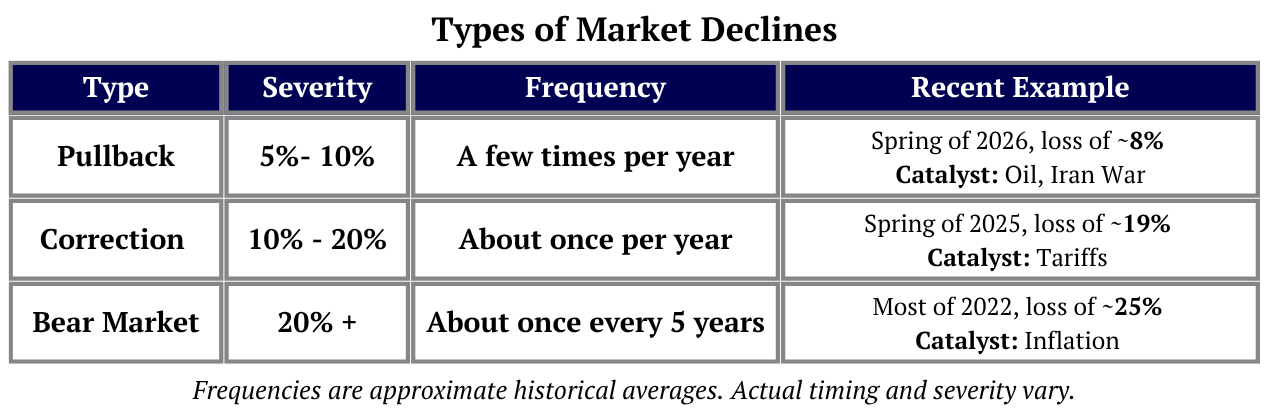
Pullbacks and corrections are common and usually short-lived. Bear markets are less frequent but more severe. In every case, history shows they have been temporary interruptions on a longer upward path. With the benefit of hindsight, prior declines have often looked like buying opportunities—though they rarely felt that way in the moment.
Stocks go up most of the time: Equities spend far more time advancing than declining, even though the downturns get most of the attention. Bad news simply sells better. Consider the S&P 500:
The hard part is that to experience the good years, you also have to accept the bad ones. You cannot reliably guess when the next decline will arrive. Accepting that reality tends to improve the investing experience.
The most useful work happens before the headlines turn ugly. A few decisions made in advance make it far easier to follow the habits in the rest of this guide when markets are falling.
Size a spending buffer.
Hold enough cash or short-term bonds to cover roughly 1–2 years of spending. Leave this money alone during normal market periods and fund your regular needs from the rest of the portfolio. Use the buffer only when markets are significantly declining, then replenish it once conditions stabilize.
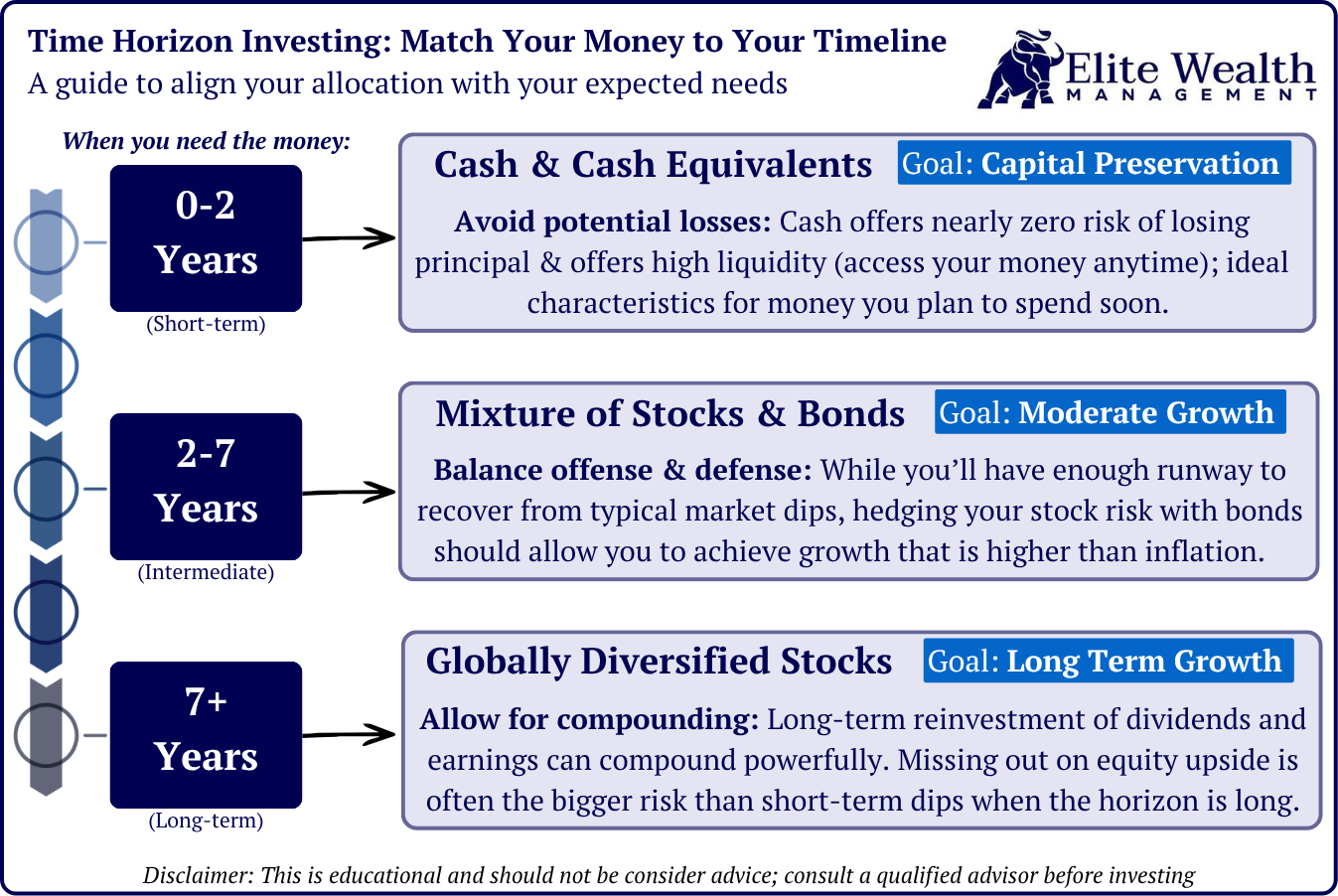
Confirm your allocation matches your timeline.
Money you will not touch for several years can generally tolerate more volatility. Money you may need soon should not be heavily exposed to stocks.
Know which accounts will fund spending.
Decide in advance where living expenses will come from if markets drop. In most cases it is better to spend from cash or taxable accounts first so you are not selling depressed stocks or creating unnecessary tax hits.
Pre-commit to the rules.
Decide in advance what you will not do in the middle of a decline: stop regular contributions, wait for an “all clear” signal, or abandon your rebalancing schedule. These rules are easier to follow when they are set ahead of time.
For those near or in retirement.
A decline early in retirement can be more damaging because you may need to withdraw while values are down. A sized buffer and a clear withdrawal plan matter more at this stage.
The goal is not to eliminate the next decline. It is to make sure a temporary drop does not force a permanent change to your plan.
Market drops are normal. They are frequent, usually short-lived, and part of how markets work. Most are mild and pass quickly. Every so often a larger one arrives and takes longer to recover from. Both are normal market behavior.
The spring of 2025 is a recent example. The S&P 500 fell nearly 19% in the first quarter before recovering to new highs by year-end.
Action step: Check your accounts quarterly instead of daily. When markets are falling, constantly watching your balance does not help. It often makes the urge to sell stronger—and selling in the middle of a decline is usually the most expensive decision an investor can make.
The media often compares the stock market to a casino, where a single bad outcome can wipe you out. Declines are part of investing, but that does not make long-term stock ownership a gamble.
From 2006 through 2025, the S&P 500 produced positive returns in 17 of 20 years and delivered an average annual return of roughly 11%. The total return over that period was more than 700%.
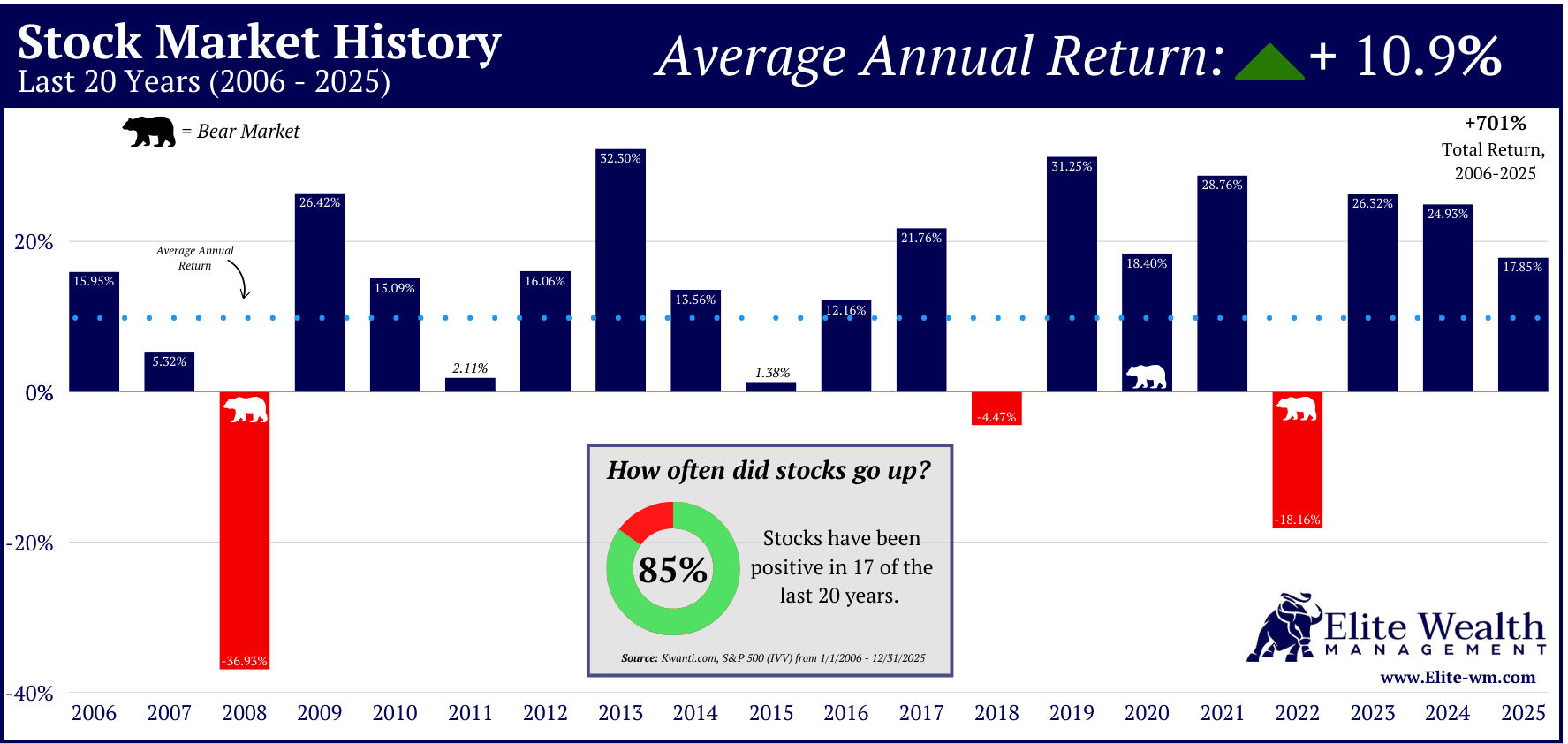
If a casino game paid like that, it would not stay open for long. This is not a 50/50 bet. It has historically been an asymmetric opportunity for investors who stay invested through the down years.
Action step: Review how your current holdings have performed in past declines (with an advisor or using tools such as Morningstar or Yahoo Finance). Compare those results to the broader market and note any areas that have consistently lagged or added unnecessary risk.
How much stock should you own? When do you need the money? Do you rely on the portfolio for income? There is no single right mix. The right allocation depends on your timeline, spending needs, and ability to stay invested when markets fall.
A 45-year-old with a long horizon might hold a high stock allocation. Someone closer to retirement may hold less. The goal is a mix you can live with in both good and bad markets.
Know the basics:
A balanced example looks like this:
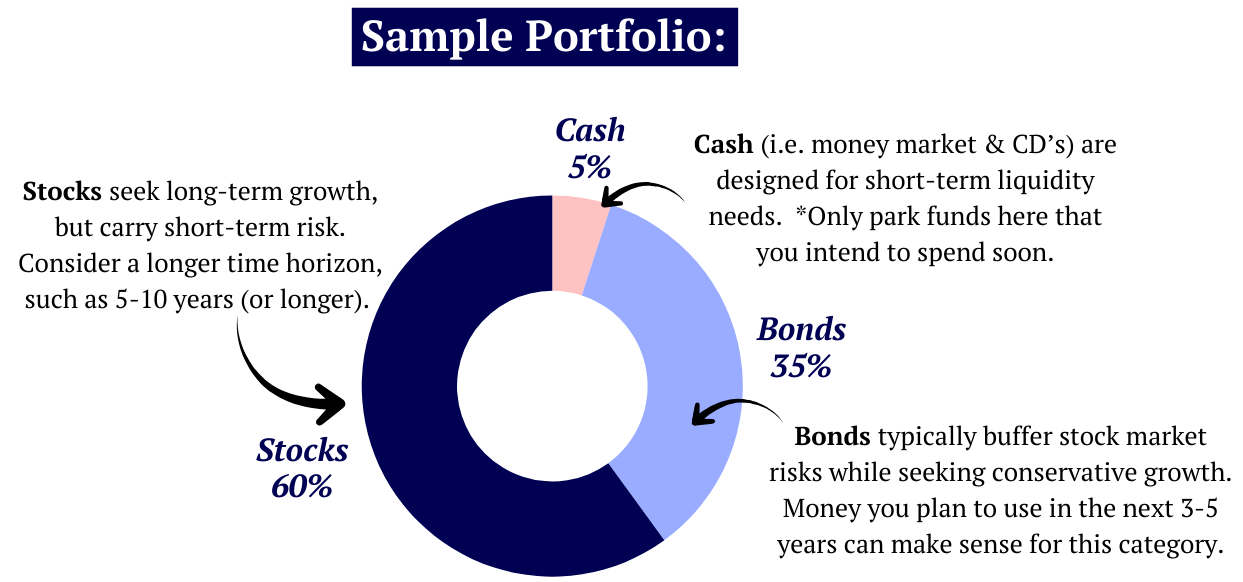
The best strategy is not the one that looks ideal on paper. It is the one you can stick with when markets are rising and when they are falling. Adjustments will still be needed as your life and goals change, but the core mix should be stable enough that you are not forced to make big decisions under stress.
Action step: Review your current allocation against your actual timeline and spending needs. Identify any areas that feel too aggressive or too conservative for the life stage you are in. The clearer the plan, the easier it is to avoid reactive changes when the next decline arrives.
When markets fall, the headlines will be loud. “Stocks Get Crushed.” “Imminent Market Crash.” “Markets in Turmoil.” The stories are designed to get attention. They are not designed to help you make better long-term decisions.
You will also hear some version of “this time is different.” It almost never is. Panic has been a constant feature of markets for generations. So have the recoveries that followed. Selling in the middle of a decline may reduce anxiety for a few days, but it has historically been an expensive way to feel better.
One of the most common phrases in a downturn is “I’m getting out until things calm down.” The problem is that there is never a clear signal that it is safe to get back in. Investors who leave often end up buying again at higher prices.
Action step: Limit news and social media during volatile periods. The historical data in this guide is more useful than the daily headlines. If you need a break, take one—step outside, spend time with people, and check your accounts on a schedule rather than whenever the market moves.
Over time, market returns will shift your portfolio away from its original mix. A conservative portfolio can become more aggressive simply because stocks rise faster than bonds. Rebalancing brings it back to target.
Rebalancing is the disciplined act of selling what has gone up and buying what has lagged. In tax-deferred accounts this can be done freely. In taxable accounts, be mindful of capital gains.
Action step: Set your target allocation (for example, 60% stocks, 35% bonds, 5% cash) and decide in advance how often you will rebalance—typically once or twice a year. Then follow the schedule regardless of what the market is doing at the time. The point is to remove emotion from the decision.
Think back to 2020, 2022, and the spring of 2025. Each was a difficult period for stock investors. Consider these questions:
In each case, staying invested turned out better than selling. Panic-selling can reduce anxiety for a short time, but it has historically been costly.
Two things can be true at the same time:
No one can tell you when the next decline will arrive. Accepting that it will eventually happen—and that you have a plan for it—makes the experience more manageable. Each downturn you live through without abandoning the plan makes the next one easier.

Important Disclaimer: Investing carries risk, past performance is not indicative of future results. All data pertaining to the "Stock Market" refers to the S&P 500, including any historical returns presented. The information provided in this guide is for educational purposes only. Any portfolio examples used are based upon a fictitious client that may resemble our typical clients. Nothing here within should be considered investment or tax advice. Please consult with a financial advisor and/or CPA when considering investment and tax decisions.

We generally serve families with $500k or more in retirement/investment assets. Our clients are seeking a trusted advisor to oversee investment decisions and retirement planning. Schedule a meeting to explore our services:
Schedule a Call
