
The internet treats a Roth conversion like a magic trick. It isn’t. It’s a tax decision: pay the IRS now, at a rate you choose, so you (or your heirs) are not stuck with that bill later. This guide covers how conversions work, when they make sense, and when they don’t.
Think of it as pre-paying the tax on purpose. A Roth conversion means you are moving money from a traditional IRA into a Roth IRA and electing to pay the income tax now versus later.
In plain English: Traditional IRAs carry a tax liability. Roth IRAs do not. You are pre-paying the tax now so the assets can be used in the future without any further taxation.
For many households, the best years sit between work ending and other income turning on. This window of time may prove to be the lowest tax bracket you'll ever experience.
For example:
The key is low taxable income. After work and before RMDs, the lower brackets often sit half empty. Once RMDs start, the IRS starts filling them for you.
Example: a $1,200,000 traditional IRA at age 73 equates to roughly $45,283 in RMD's; that's taxable income— whether you need the cash or not. Stack that on top of Social Security and a pension, and it can:
Everyone can convert. The bracket you convert in is what matters:
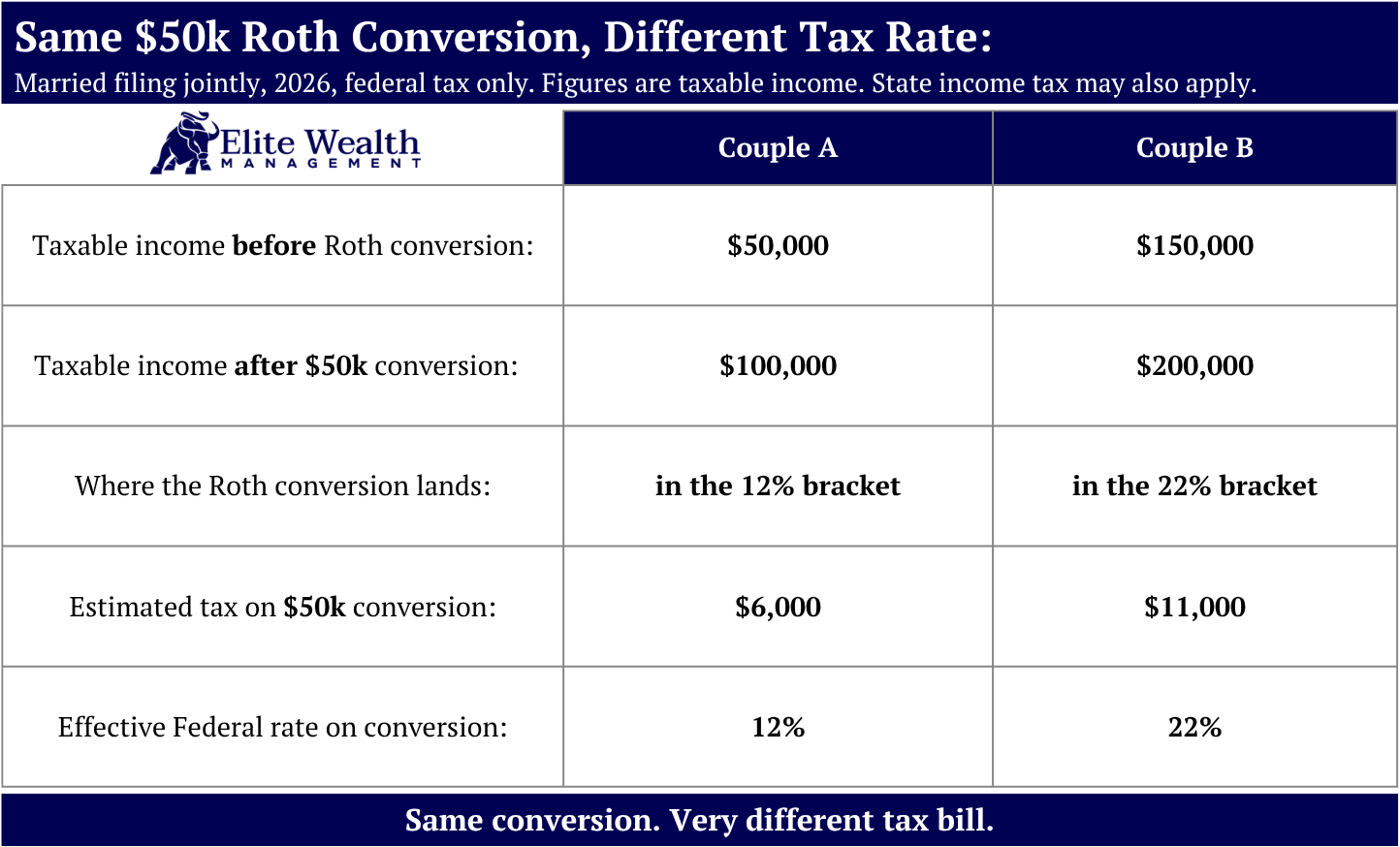
Key observation- Roth conversions are not suitable for everyone: I see a lot of clients start a pension the day they retire. They spend the rest of retirement in an elevated bracket. For those households, the tax math on a conversion often does not work.
A conversion raises this year’s tax bill on purpose. The point is a smaller bill later — and more control over when income shows up. Treat it as an annual decision, not a one-time cleanup.
Smaller RMDs
RMDs are taxable whether you need the cash or not. Move part of a traditional IRA to a Roth and that slice is no longer in the balance the IRS will force out. A smaller traditional IRA means a smaller RMD, and less income stacked on Social Security and everything else. Roth IRAs have no lifetime RMDs for the original owner. Important rule: if you are already of RMD age: take the RMD first. That distribution cannot be converted. Only dollars above the RMD can move to a Roth.
A Cleaner Inheritance
You pay the tax now, at a rate you choose, so heirs inherit a Roth instead of a traditional IRA with a tax bill attached. Qualified withdrawals can be tax-free for them. Most non-spouse heirs still must empty an inherited Roth within 10 years, but those withdrawals are generally tax-free if the account was qualified. That is often cleaner than pushing a large taxable IRA through a decade of their working years.
✓ A conversion moves traditional IRA money into a Roth and creates a tax bill this year.
✓ You are pre-paying the tax so you — or your heirs — are not handed that bill later.
✓ The better years are often when taxable income is temporarily low: after work stops, before Social Security and RMDs.
✓ Converting can cut future RMDs, manage later-year taxes, and leave a cleaner account for a spouse or heirs.
✓ Size the conversion to this year’s bracket and the rest of the plan — not to a round number or this year’s tax bill alone.
Ready to Get Started? Click here to invest with us.

Important Disclaimer: The information provided in this guide is for educational purposes only. Any examples used are based upon a fictitious client(s) that resembles our typical clients. Nothing here within should be considered investment or tax advice. Please consult with a financial advisor and/or CPA when considering investment and tax decisions. This is not personalized investment advice.

We generally serve families with $500k or more in retirement/investment assets. Our clients are seeking a trusted advisor to oversee investment decisions and retirement planning. Schedule a meeting to explore our services:
Schedule a Call
.png)