
If you’ve ever had this thought, you’re not alone. The desire to protect hard-earned savings is completely understandable. Yet while the idea of “playing it safe” feels prudent, it can quietly work against long-term investment and retirement goals. This mindset is often rooted in fear—the belief that investing in stocks could destroy a nest egg. This guide aims to show a different reality: the stock market has historically been one of the most powerful wealth-creation tools available to everyday investors.
Inflation is often called the silent thief—and for good reason. It rarely arrives with the drama of a market crash, yet it steadily reduces the real value of money left sitting in cash or low-yielding accounts. Over the past 20 years, inflation averaged roughly 2.5% per year and eroded nearly 40% of a dollar’s purchasing power. A balance that looked stable on paper bought less and less over time. For investors focused only on avoiding market losses, this slow and persistent loss of purchasing power proved to be one of the most significant risks of all.

Cash is often viewed as the ultimate safe haven, but history shows it generally fails to match the rising cost of goods. Over the past 20 years, yields on savings accounts spent long stretches near 0%—well below the roughly 2.5% average rate of inflation. Over time, holding large amounts of cash proves far less “safe” than many investors assume.

Bottom line on cash: Keeping long-term money parked in cash is often a losing proposition. When short-term yields fail to keep pace with inflation, spending power erodes.
___________________________________________________________________________________________________

For many readers, the idea of stock investing still feels unsettling—almost like a high-stakes gamble where one bad stretch could wipe out years of savings. The data tells a different story:

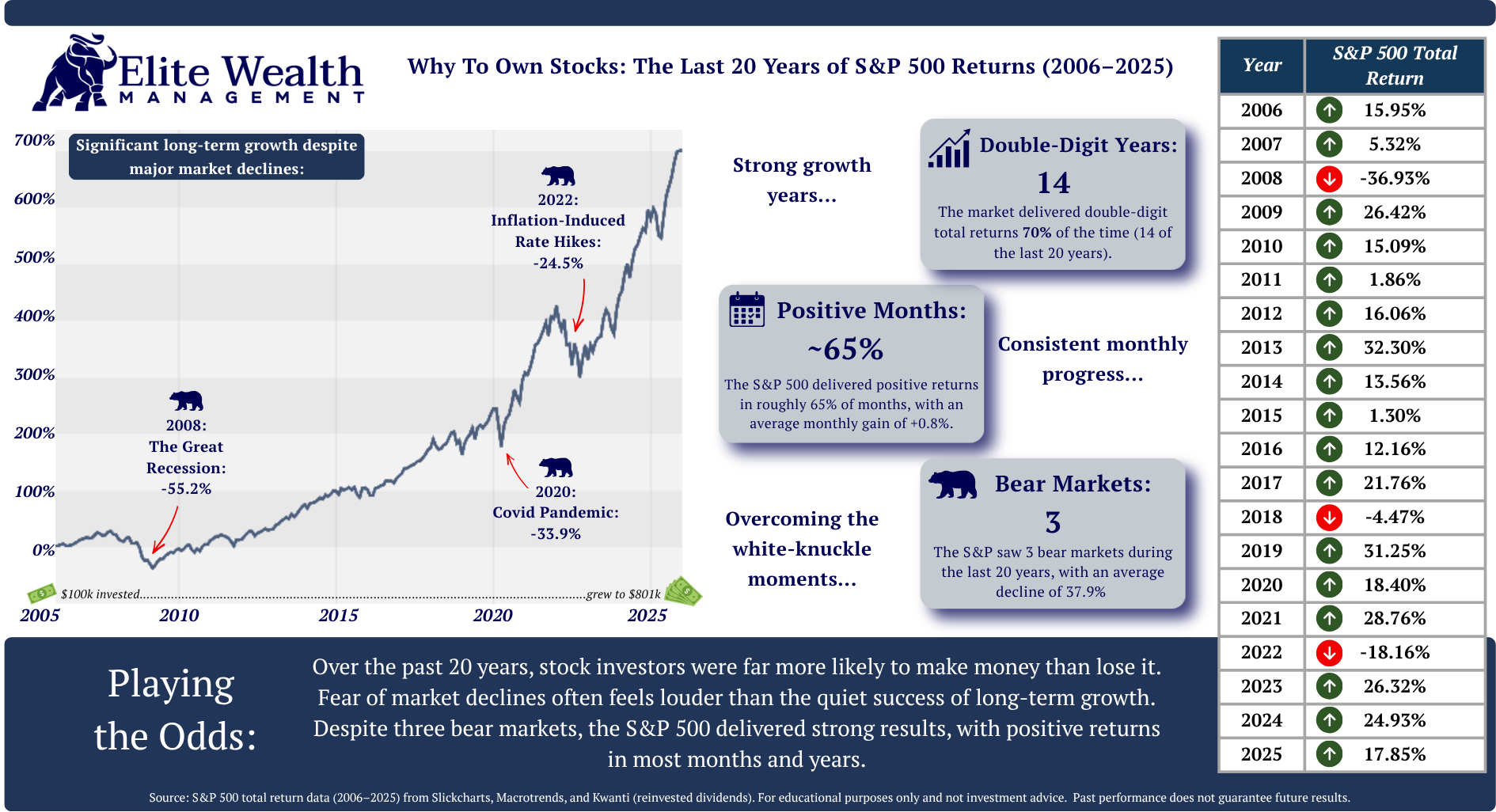
A little research proves that over the past 20 years, the market has been anything but a gamble. The S&P 500 produced POSITIVE returns in 17 of the last 20 years— an 85% annual win rate.
"Yeah, but the next market crash is right around the corner..."
Quite possibly...but this is because market downturns are normal. In fact, the S&P 500 has historically experienced a bear market (a decline of 20% or more) roughly once every 5–6 years. Stock market investing is often described as taking the stairs up and the elevator down: gains tend to build gradually, while declines can feel sudden and steep. Yet those sharp drops have historically been temporary interruptions rather than the dominant trend. Over long periods, the market has spent far more time advancing than declining, rewarding investors who stayed the course through the inevitable downturns.
The last 20 years were no exception. The S&P 500 endured three significant bear markets, including the severe drop of 2008 and the rapid decline during the 2020 pandemic. In each case, the market recovered and continued higher:
Think of it like a weather forecast calling for an 85% chance of sunshine and a 15% chance of rain. Most people would not view those odds as a losing proposition.
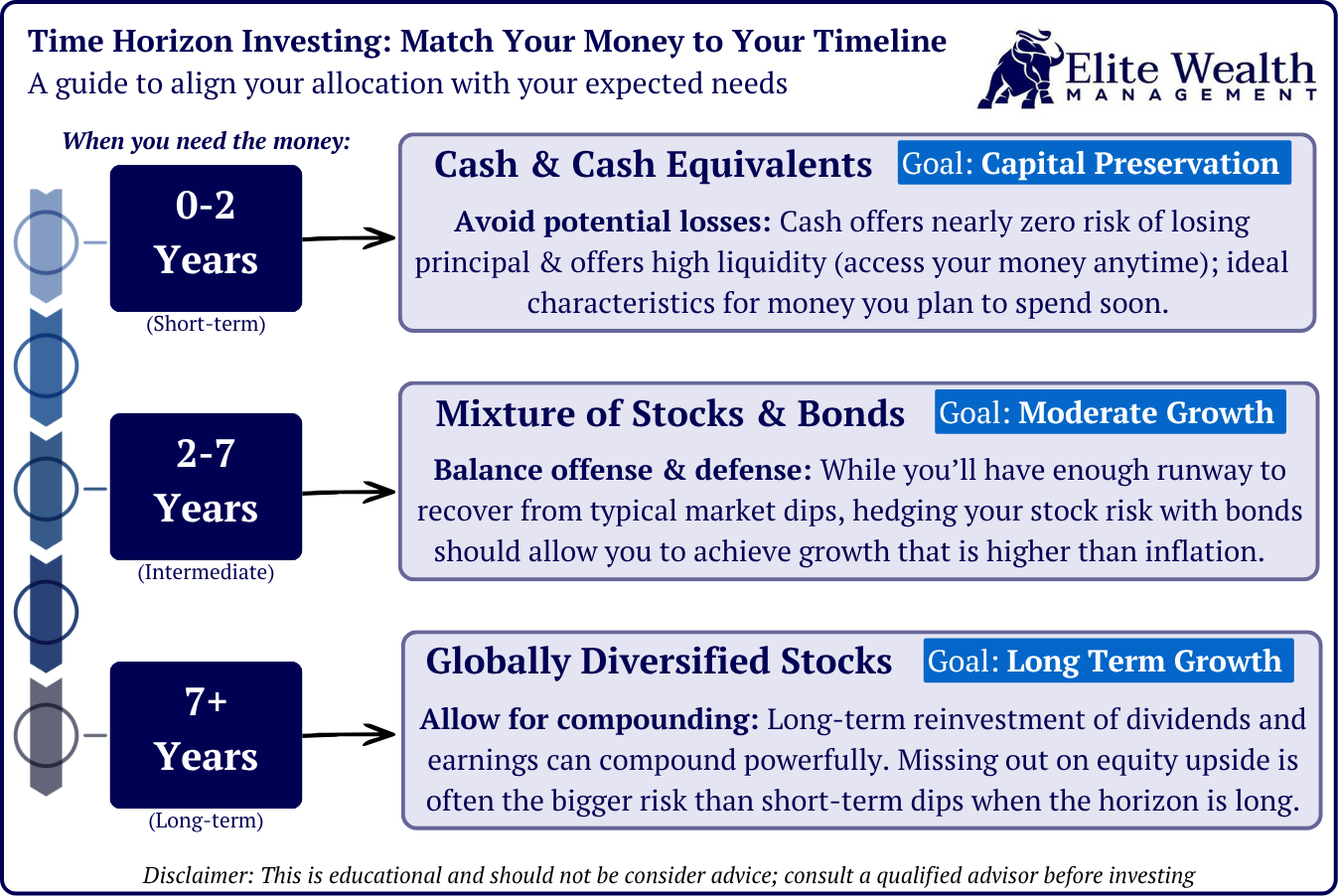
Of course, stocks involve risk, and past performance does not guarantee future results. But the historical evidence is clear: the longer money stays on the sidelines, the more potential growth is left behind.
Playing it safe can actually be quite dangerous. Inflation is one of the most reliable forces investors face. Allowing your money the opportunity to compound through diversified stock investing has historically improved the odds of meeting long-term goals. The market’s long-term upward bias rewards participation far more than prediction. Create or revisit your investment plan, stay diversified, and let time and compounding do the heavy lifting.
Ready to Get Started? Click here to invest with us.

Important Disclaimer: The information provided in this guide is for educational purposes only. Any examples used are based upon a fictitious client(s) that resembles our typical clients. Nothing here within should be considered investment or tax advice. Please consult with a financial advisor and/or CPA when considering investment and tax decisions. Based on Schwab’s analysis (updated July 2025). This is not personalized investment advice.

We generally serve families with $500k or more in retirement/investment assets. Our clients are seeking a trusted advisor to oversee investment decisions and retirement planning. Schedule a meeting to explore our services:
Schedule a Call
.png)